Collectibles & miniatures
Explore detailed characters, display pieces and fantasy creatures. Learn the difference between printing and finishing a piece.
YOUR FIRST PRINT STARTS WITH A PLAN
From choosing a printer to making something you’re proud of. Learn the essentials, solve common mistakes, and explore turning your creations into a small business.
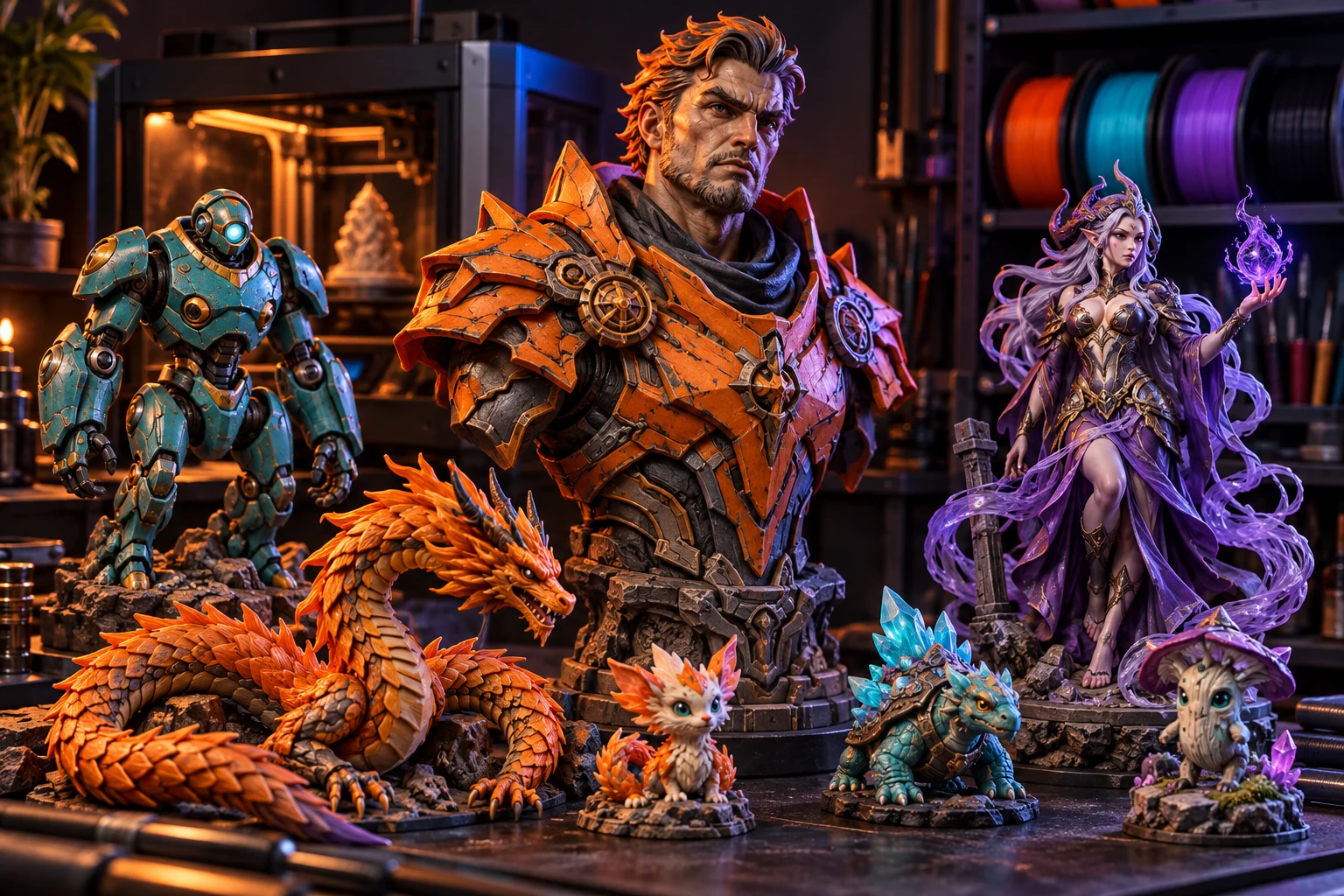
A world of possibilities, one layer at a time.
PDF e-book · American English · Beginner friendly
The possibilities
Dragons that bend, robots, collectibles, gifts and useful things for your desk. The guide teaches the skills behind prints like these.
Explore detailed characters, display pieces and fantasy creatures. Learn the difference between printing and finishing a piece.
Names, custom details and thoughtful little objects. Start with a simple idea that you can make your own.
Stands, organizers and useful parts. Discover how a practical need can become your next project.
The collectible scene is an illustrative visualization. Painted finishes require additional work. Physical figures and STL files are not included. Check commercial licenses before selling prints.
What you'll learn
7 parts and 19 chapters, in the order you will need them.
Inside the book
These are images of pages from the final e-book. Pick a page to see it larger.
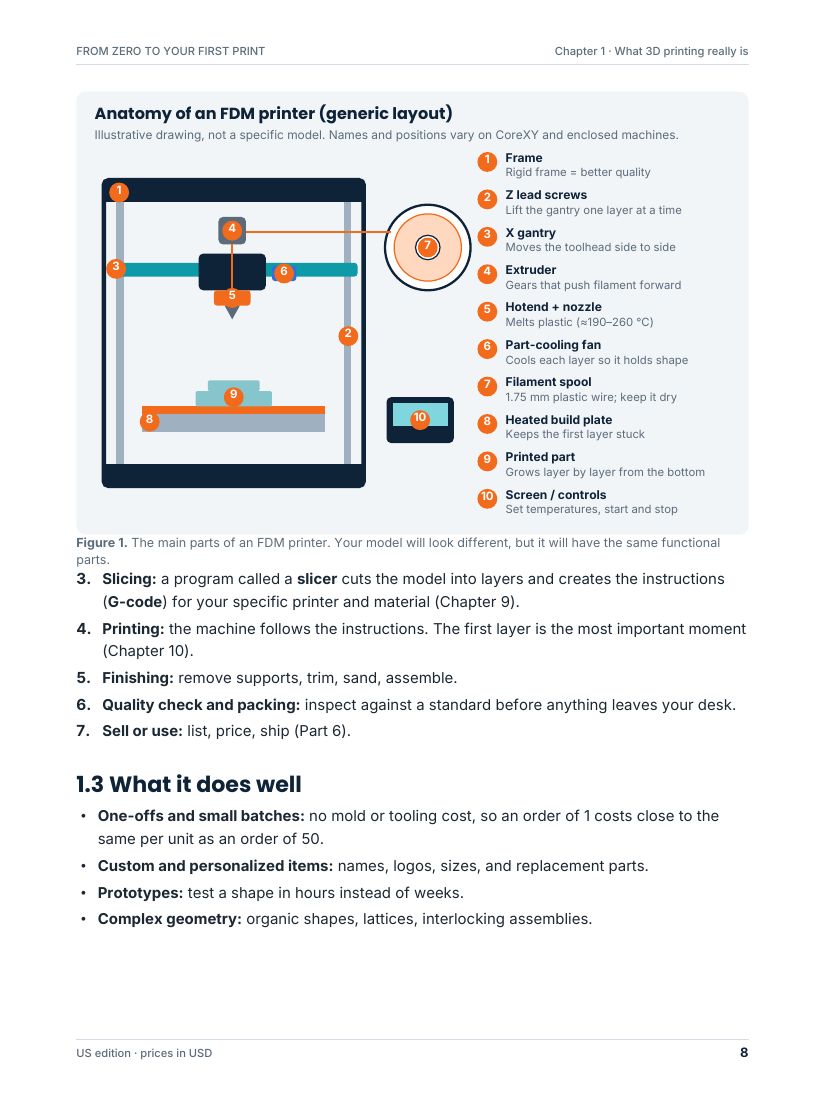
Page 8 · Anatomy of an FDM printer (generic layout)
Prices and examples in the book are dated October 4, 2026. Pricing examples are hypothetical and meant to teach the method.
Is it for you?
Read Parts 1 to 3 first. You will know what to look for, what it really costs and how to set up a safe space.
Follow the first-print routine, learn the settings that matter and use the symptom table when something goes wrong.
Use the troubleshooting method, the maintenance rhythm and the quality checklist to print more reliably.
Check licenses, run the cost math and test an idea cheaply before you spend on equipment or inventory.
Experience needed: none. No prior 3D printing or 3D modeling knowledge is assumed.
What's included
Pages in the book to copy or recreate in a spreadsheet. They are not separate files.
No printer, no model (STL) files, no software and no separate spreadsheet files. The illustrated figures on this page are examples, not downloads. The guide is not legal, tax or financial advice.
How the guide is organized
Digital guide
The Practical Beginner's Guide to 3D Printing
Price shown at checkout
Get the 3D Printing GuideDigital product, not a physical item. Format: PDF. Language: English (U.S.). You will receive the file through the checkout platform.
Questions
No. The guide is useful before you buy. It helps you decide what to buy, what it will really cost and how to set up a safe space. If you already own a printer, start with the first-print and troubleshooting chapters.
Yes. It assumes no prior experience and explains terms in plain English, with a glossary at the end.
Yes. It compares FDM (filament) and resin (MSLA) printing, covers the main filaments in detail and has a chapter on resin types, workflow and safety. Powder (SLS) is explained briefly.
Yes. You get twelve selection criteria, a price snapshot of popular printers dated October 4, 2026, three starter budgets and a guide to total cost of ownership. It is a method, not a "best printer" list, because prices and models change.
Yes. It covers unit cost, failure rate, platform fees, shipping, markup vs. margin and break-even, with three hypothetical worked examples and a cost sheet template.
No. The guide shows where to find licensed models and which free tools beginners can use to make simple ones. Modeling is optional at the start.
No. The dragons, robots and other figures are illustrations of what 3D printing can make. The guide does not include model files or physical items.
American English. You get one PDF. The bonus toolkit is part of the PDF, with pages you can copy or recreate in your own spreadsheet.
You receive it through the checkout platform after purchase. The platform shows the delivery steps when you check out.
It can help you test an idea in a structured way: check licenses, calculate costs, set prices and decide whether to continue. It does not promise income. Results depend on practice, demand, costs, competition and how you execute. The financial examples are hypothetical, and the book recommends talking to a local accountant or attorney about taxes, permits and legal questions.
Digital PDF guide · American English · 65 pages